
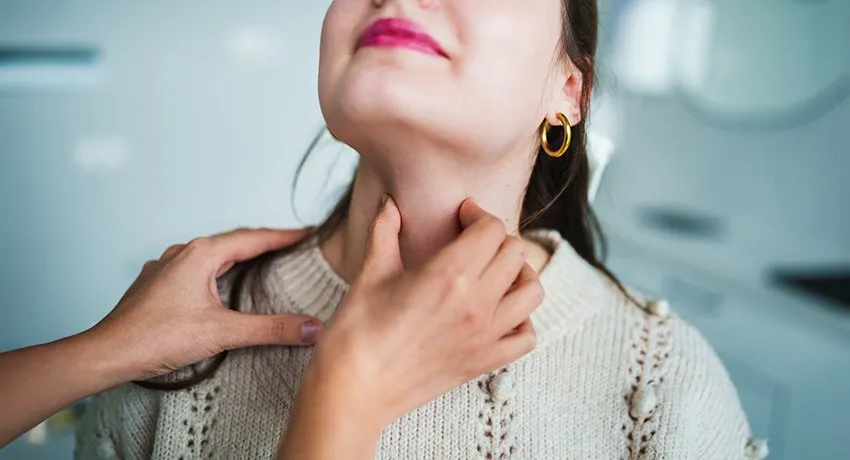
A 42-year-old woman walks into clinic exhausted, gaining weight, losing hair, and sleeping poorly. Her TSH is 6.8 mIU/L, free T4 is mid-range, and TPO antibodies were never ordered. Under the dominant interpretation of American Thyroid Association (ATA) guidance, she sits in the “watch and wait” zone — too mildly elevated for automatic treatment, too symptomatic to ignore. This is the gap where many nurse practitioners lose patients to wellness clinics, and it is also where most of the meaningful clinical conversation about subclinical hypothyroidism treatment actually happens.
Thyroid dysfunction is not a standalone disease in women’s health. It overlaps with perimenopause, fertility, iron status, and even GLP-1 prescribing decisions. The job of an NP working with midlife women is to read the thyroid in context — not as a single TSH number, but as a signal embedded in a larger hormone story.
Why thyroid sits at the center of women’s hormone care
Hypothyroidism is roughly five to eight times more common in women than men [verify], and the prevalence rises through the perimenopausal years. Symptoms of low thyroid function — fatigue, brain fog, weight gain, mood changes, menstrual irregularity, hair thinning, cold intolerance — overlap almost completely with perimenopause. Without a full thyroid workup, it is clinically impossible to tell which symptoms belong to which physiology.
The interaction is bidirectional. Estrogen increases thyroid-binding globulin, which can reduce free hormone availability and increase the levothyroxine dose required in women starting oral estrogen therapy. Progesterone influences thyroid receptor sensitivity. Cortisol shifts T4-to-T3 conversion. In other words, thyroid never moves alone — and in midlife women, treating thyroid without considering ovarian and adrenal physiology produces incomplete results.
This is the framing the EWHH-C Women’s Health & Hormone Certification is built around: thyroid as a hormone, not a silo.
What conventional guidelines say versus functional assessment
The ATA, the American Association of Clinical Endocrinologists (AACE), and the Endocrine Society broadly agree on the diagnostic floor: overt hypothyroidism (TSH above the reference range with low free T4) should be treated. Where guidance diverges is in the subclinical zone — TSH elevated, free T4 normal — and in whether to look beyond TSH at all.
- ATA / AACE conventional position: TSH is the screening test of record. Treatment of subclinical disease is generally considered for TSH greater than 10 mIU/L, or for TSH 4.5–10 with symptoms, positive TPO antibodies, pregnancy, infertility, or cardiovascular risk [verify].
- Endocrine Society and NEJM trial signal: Large RCTs, including the TRUST trial published in NEJM, have questioned the symptomatic benefit of treating mild subclinical hypothyroidism in older adults [verify]. This evidence is real and should temper enthusiasm for reflexive treatment.
- Functional / integrative position: A narrower TSH “optimal” target (often cited as approximately 1.0–2.5 mIU/L), routine measurement of free T3, reverse T3, and antibodies, and willingness to treat symptomatic patients earlier — particularly when TPO antibodies are positive.
The honest clinical reality is that none of these positions is wrong; they answer different questions. ATA answers “what is the minimum threshold supported by mortality and progression data?” The functional view answers “what does this patient need to feel well?” An informed NP holds both, and is transparent with patients about which question is being answered.
The full thyroid panel
A single TSH is sufficient for screening in asymptomatic patients. It is rarely sufficient for the symptomatic midlife woman. A fuller panel allows the clinician to see central versus peripheral problems, conversion issues, and autoimmunity.
Full thyroid panel reference table
| Marker | Conventional reference range | Functional / optimal range | What it tells you |
| TSH | ~0.4–4.5 mIU/L | ~1.0–2.5 mIU/L | Pituitary signal; first-line screen |
| Free T4 | ~0.8–1.8 ng/dL | Mid- to upper-half of range | Circulating prohormone |
| Free T3 | ~2.3–4.2 pg/mL | Upper third of range | Active hormone at the tissue |
| Reverse T3 | ~9–24 ng/dL | Lower half of range; FT3:rT3 ratio >20 | Conversion / stress signal |
| TPO antibodies | <34 IU/mL (assay-dependent) | Negative | Hashimoto’s autoimmunity |
| Thyroglobulin antibodies (TgAb) | <40 IU/mL (assay-dependent) | Negative | Hashimoto’s autoimmunity |
The “functional / optimal” column is a clinical heuristic used in integrative practice, not a guideline-endorsed cutoff. Reference ranges vary by assay and laboratory; always interpret against the laboratory’s stated range. When optimal and reference ranges diverge, that divergence is a conversation to have with the patient, not a diagnosis.
Subclinical hypothyroidism treatment — when to treat
For practical purposes, the subclinical hypothyroidism treatment decision tree most NPs can defend in chart and to colleagues looks like this:
- TSH >10 mIU/L: Treat. This is consistent with ATA, AACE, and Endocrine Society guidance [verify].
- TSH 4.5–10 mIU/L with positive TPO antibodies, pregnancy, infertility, or cardiovascular risk: Treatment is reasonable and supported by guidelines in defined subgroups [verify].
- TSH 4.5–10 mIU/L, asymptomatic, older adult: Trial evidence (e.g., TRUST) suggests limited symptomatic benefit; observation is defensible [verify].
- TSH 4.5–10 mIU/L, symptomatic woman in perimenopause: This is the contested zone. A shared-decision trial of levothyroxine with re-evaluation at 8–12 weeks is a defensible middle path, provided the patient understands the evidence.
The clinical mistake is not choosing one position; it is failing to document the reasoning. Subclinical hypothyroidism treatment is a conversation, not a reflex.
Hashimoto’s thyroiditis — autoimmune workup and management
Hashimoto’s is the most common cause of hypothyroidism in iodine-sufficient populations and is responsible for the majority of cases NPs will see in women. Workup is straightforward: TPO antibodies, thyroglobulin antibodies, and thyroid ultrasound when indicated.
Two clinical points matter. First, antibody-positive patients with normal TSH still have Hashimoto’s; they are simply earlier in the disease arc. These patients deserve closer follow-up — annual TSH at minimum — and a frank conversation about symptoms and progression. Second, Hashimoto’s is an autoimmune condition, and the modifiable inputs that influence other autoimmune disease (gut health, vitamin D status, stress, nutrient adequacy) are reasonable adjuncts. They are not substitutes for thyroid hormone replacement when replacement is indicated.
The question “Is Hashimoto’s the same as hypothyroidism?” is one of the most common patient questions. The answer is no: Hashimoto’s is the underlying autoimmune process; hypothyroidism is the downstream functional state. A patient can have one without the other for years.
Thyroid, perimenopause, and HRT
Perimenopause and subclinical thyroid disease present so similarly that they are functionally indistinguishable on symptom report alone. Fatigue, weight changes, mood instability, sleep disruption, and brain fog appear in both. The clinical workflow that makes the most sense is to evaluate both in parallel rather than sequentially: a full thyroid panel and a perimenopause symptom assessment at the same visit.
HRT prescribing intersects with thyroid in two important ways. Oral estrogen increases thyroid-binding globulin and can necessitate a higher levothyroxine dose in already-treated patients; transdermal estrogen has less effect. And progesterone status influences how patients tolerate thyroid replacement, particularly for sleep and mood. NPs prescribing HRT should re-check TSH approximately 6–8 weeks after starting or changing estrogen therapy in any patient on thyroid hormone. The HRT Complete Clinical Guide for NPs covers the prescribing logic in detail.
Thyroid and GLP-1 considerations
GLP-1 receptor agonists carry a boxed warning for medullary thyroid carcinoma (MTC) based on rodent data, with contraindications in patients with personal or family history of MTC or multiple endocrine neoplasia type 2 (MEN2). The human risk signal is much weaker, but the screening responsibility is real.
For NPs prescribing semaglutide, tirzepatide, or other GLP-1s — including in microdosing protocols — baseline screening should include a family history of MTC/MEN2, a thyroid exam, and a baseline TSH. Routine calcitonin screening is not currently recommended by major societies [verify]. Thyroid nodules discovered during workup should be evaluated by ultrasound per ATA nodule guidance before initiating GLP-1 therapy. For the broader prescribing framework, see GLP-1 Microdosing for Nurse Practitioners.
Iron, ferritin, and iodine — the cofactors that matter
Thyroid hormone synthesis and conversion depend on micronutrient adequacy. Two cofactors deserve specific NP attention: iron and iodine.
Iron deficiency, even without anemia, impairs T4-to-T3 conversion and worsens hypothyroid symptoms. Ferritin below approximately 50 ng/mL is associated with thyroid-related fatigue and hair loss in women [verify], and many menstruating women sit below this threshold. Elite NP has covered this in depth in The Functional Medicine Approach to Ferritin for Thyroid Patients.
Iodine is the more delicate cofactor. In iodine-deficient populations, supplementation supports thyroid function; in iodine-sufficient populations, excess iodine can precipitate or worsen autoimmune thyroid disease. The United States is broadly iodine sufficient, which means high-dose iodine supplements are not a generic intervention. The clinical pearl on this is summarized in How Much Iodine Is Too Much.
Selenium, zinc, and vitamin D also play roles in thyroid physiology and antibody trajectory, but iron and iodine are the two most clinically actionable in primary care.
Levothyroxine, NDT, and T3 — clinical considerations
Levothyroxine (T4 monotherapy) is the standard of care endorsed by ATA, AACE, and the Endocrine Society. It is well-studied, dose-titratable, and effective for most patients. It should be the starting point for nearly every patient who needs replacement.
A subset of patients remain symptomatic on adequate T4 monotherapy despite normalized TSH. For these patients, combination T4/T3 therapy or natural desiccated thyroid (NDT) preparations are sometimes considered. The evidence base here is genuinely mixed: some trials show symptomatic benefit, others do not, and pooled analyses have not established clear superiority over levothyroxine [verify]. NDT carries additional considerations around batch consistency and supraphysiologic T3 ratios.
T3-only therapy is more controversial still, with limited high-quality evidence and meaningful concerns about cardiac and bone outcomes at supratherapeutic levels. It is not a first-line approach and should not be framed as such.
The defensible NP position is: start with levothyroxine, titrate to symptoms and TSH, investigate cofactors and HRT interactions when patients remain symptomatic, and consider combination therapy as a shared-decision option with informed consent — not as a default upgrade.
How EWHH-C teaches thyroid optimization
Module 4 of the Elite NP Women’s Health & Hormone Certification walks through this decision logic with case-based teaching: how to order and interpret a full panel, how to handle the TSH 4.5–10 patient in front of you, how to coordinate thyroid replacement with HRT and GLP-1 prescribing, and how to document the reasoning behind a non-standard treatment choice. The goal is not to replace ATA guidance with a parallel functional protocol; it is to teach NPs to read the guideline, see the patient, and document the bridge.
Frequently asked questions
When should subclinical hypothyroidism be treated? Treatment is generally indicated when TSH is above 10 mIU/L. For TSH 4.5–10 mIU/L, treatment is reasonable in pregnancy, infertility, positive TPO antibodies, cardiovascular risk, or symptomatic patients — based on shared decision-making and guideline subgroups [verify].
What is a full thyroid panel? A full thyroid panel typically includes TSH, free T4, free T3, reverse T3, TPO antibodies, and thyroglobulin antibodies. TSH alone is adequate for screening; the full panel is more informative when patients are symptomatic or have known thyroid disease.
Is Hashimoto’s the same as hypothyroidism? No. Hashimoto’s is an autoimmune condition in which the immune system attacks the thyroid gland. Hypothyroidism is the functional state of low thyroid hormone. Hashimoto’s is the most common cause of hypothyroidism, but patients can have antibodies long before TSH rises.
Can you treat thyroid disease without medication? Overt hypothyroidism requires thyroid hormone replacement; lifestyle alone is not sufficient. In subclinical and autoimmune-only disease, addressing nutrient cofactors (iron, iodine status, selenium, vitamin D), gut health, and stress can support thyroid function, but these are adjuncts, not substitutes for indicated replacement.
How does perimenopause affect thyroid? Perimenopause and thyroid dysfunction share nearly all major symptoms and frequently coexist. Estrogen changes affect thyroid-binding globulin and levothyroxine dosing. NPs should evaluate thyroid and ovarian hormone status in parallel rather than sequentially in midlife women.
What is reverse T3? Reverse T3 is an inactive metabolite of T4. Elevations can reflect physiologic stress, illness, or impaired conversion of T4 to active T3. It is not a stand-alone diagnostic, but interpreted alongside free T3 it can suggest a conversion problem rather than a primary thyroid problem.
Do GLP-1 medications cause thyroid cancer? Human evidence does not establish a clear causal link, but rodent data led to a boxed warning for medullary thyroid carcinoma. GLP-1s are contraindicated in patients with personal or family history of MTC or MEN2. Baseline screening should include family history and TSH; routine calcitonin testing is not currently recommended [verify].
Thyroid optimization is one of the most consequential — and most often under-managed — areas of women’s health primary care. For NPs ready to handle the full decision tree in their own practice, explore the Elite NP Women’s Health & Hormone Certification.
